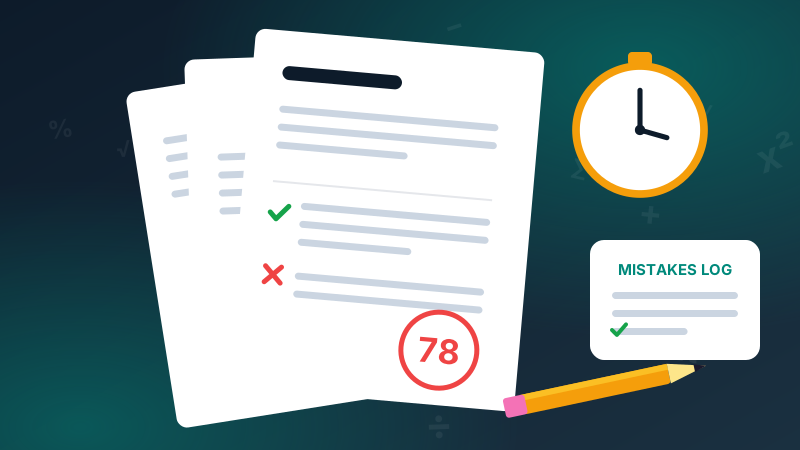
Past papers are the single best revision tool you have. But doing a paper, glancing at your score and moving on wastes about 80% of their value. The learning happens after you finish.
Step 1: Know when to use them
Don't start with full papers. Early in Year 11, use topic-by-topic question packs so you can practise one skill at a time. Save full papers for the last three to four months, when you need timing and stamina.
Step 2: Do them under real conditions
Phone in another room. Timer on. Only the equipment you're allowed in the exam. If it's a non-calculator paper, no calculator — not even "just to check".
Step 3: Mark with the official mark scheme
Mark schemes show you how marks are awarded, not just the final answer. You'll often find you'd have picked up method marks for working you didn't bother writing down. That's a lesson in itself.
Step 4: Keep a mistakes log
This is the step almost everyone skips. For every lost mark, write down:
- The question and topic
- What went wrong: didn't know it, misread it, careless slip, or ran out of time
- What you'll do differently
After five papers, patterns jump out. If most lost marks are "misread the question", that's a technique problem, not a knowledge one — and it's much quicker to fix.
Step 5: Redo the questions you got wrong
A week later, redo only the questions from your log, without looking at the answers. If you get them right, cross them off. If not, they stay on the list.
Where to find papers
Your exam board's website (AQA, Edexcel/Pearson, OCR) publishes recent papers and mark schemes. Free sites such as Physics & Maths Tutor collect papers by board and topic. Check you're using the right board and specification.