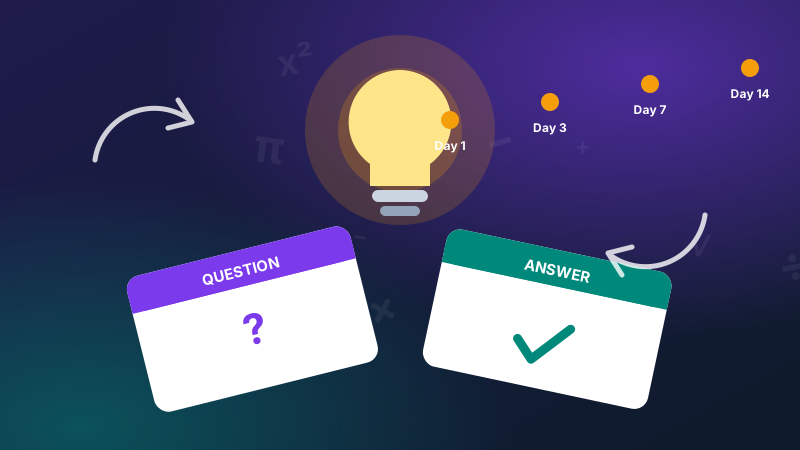
Re-reading notes and highlighting feel productive. The trouble is, they mostly build familiarity, not memory. You recognise the page, so you think you know it — until the exam asks you to produce it from scratch. Two techniques backed by decades of learning research fix this: active recall and spaced repetition.
Active recall: test yourself, don't review yourself
Active recall means pulling information out of your head instead of putting it back in. It feels harder, and that's exactly why it works. Try these:
- Blurting: write everything you remember about a topic on a blank page, then check your notes and fill the gaps in a different colour.
- Flashcards: question on the front, answer on the back. Say the answer aloud before you flip.
- Past paper questions: the ultimate form of recall, because it's exactly what the exam asks you to do.
- Teach it: explain a topic to a parent, sibling or pet. If you can't explain it simply, you don't know it yet.
Spaced repetition: little and often beats one long session
We forget new information fast unless we revisit it. Spacing your reviews out — for example, after one day, then three days, then a week, then a fortnight — resets that forgetting and makes memories stick.
In practice: don't revise a topic for three hours on Sunday and never again. Revise it for 30 minutes on Sunday, 15 on Wednesday and 15 the following week.
Mix your topics
Doing 20 questions on one topic in a row is easy, because you know which method to use. In the exam, questions are mixed. Practising mixed sets (called "interleaving") trains you to recognise which method a question needs.
A simple weekly routine
- Learn or review a topic (20 minutes)
- Close the book and blurt (10 minutes)
- Do exam questions on it (20 minutes)
- Add anything you got wrong to flashcards and revisit it next week