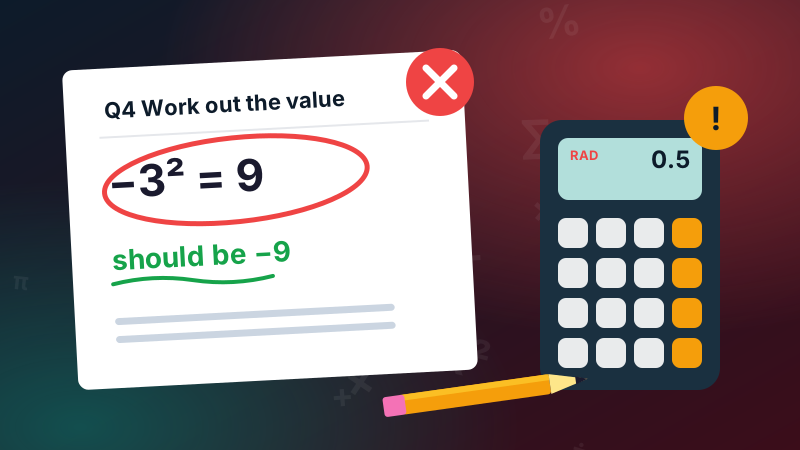
Every summer, students lose marks in GCSE Maths not because they don't know the topic, but because of avoidable slips. Fix these eight and you could pick up a grade without learning anything new.
1. Not showing working
Most multi-mark questions award method marks. A wrong final answer with clear working can still score most of the marks. A wrong answer with no working scores zero.
2. Rounding too early
Round only at the very end. Rounding halfway through a calculation — especially in trigonometry or compound interest — can push your final answer outside the accepted range.
3. Ignoring the units and the accuracy asked for
If the question says "give your answer to 3 significant figures" or "in cm²", that's where a mark lives. Circle these instructions when you first read the question.
4. Negative number slips
Squaring a negative (−3² vs (−3)²), subtracting a negative, and expanding −(x − 4) are all classic traps. Slow down whenever a minus sign is involved.
5. Calculator in the wrong mode
If your calculator is in radians instead of degrees, every trig answer will be wrong. Check for a small "D" on the display at the start of every calculator paper.
6. Answering a different question
"Show that" questions need every step written, even if the answer is given. "Explain" questions need words, not just numbers. Read the command word twice.
7. Forgetting to finish the question
Students often find x and stop — when the question asked for the size of the angle, or the total cost. Before moving on, reread the last line of the question.
8. Leaving blanks
If you're stuck, write down anything relevant: a formula, a first step, a sketch. Early method marks are often available even if you can't finish.