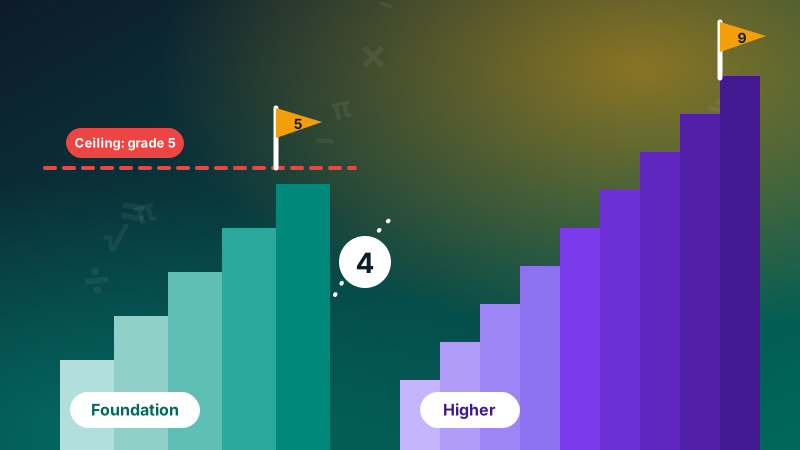
In GCSE Maths, Combined and Separate Sciences, and Modern Foreign Languages, students sit either Foundation or Higher tier papers. The choice caps the grades available, so it's worth understanding before your child's school makes the call.
What grades each tier allows
| Tier | Grades available | Best suited to |
|---|---|---|
| Foundation | 1–5 | Students working securely at grades 3–5 |
| Higher | 4–9 (a 3 is allowed in some cases) | Students aiming for 5 and above |
The overlap is grades 4 and 5. A student can earn a 5 on either paper — but on Foundation, a 5 is the ceiling.
The risk on each side
- Foundation: the maximum is a 5. If your child is capable of a 6, they can't get it.
- Higher: the papers start at grade-4 difficulty and climb quickly. A student who falls short of the grade 4 boundary on Higher may get a 3, or be ungraded (U), even if they'd have comfortably scored a 4 on Foundation.
Why grade 4 matters so much in Maths
A grade 4 is the "standard pass". Students in England who don't achieve at least a 4 in Maths and English must keep studying them after 16. Many sixth forms ask for a 6 or higher to take A-Level Maths, which is only possible on Higher.
Questions to ask your child's teacher
- What tier are they entered for, and when is the final decision made?
- What grades are they currently working at on each tier's papers?
- Is there any chance of moving tier if their mock results improve?
A practical test
Ask your child to sit a recent Higher paper under timed conditions and mark it against the grade boundaries. If they're comfortably clearing the grade 4 threshold, Higher is usually the right call.